Tags
IA Tech & Growth
AI custom autofill
Improve AI search visibility with clear answers, original evidence, strong technical foundations, and consistent brand mentions.
Published
Best Practices:
- Find first
- Once found how to leverage
Approach | More accurate wording |
SEO | Improve organic search visibility and attract qualified visitors |
AEO | Become a source for direct answers, including AI answers |
GEO | Be accurately mentioned, cited or recommended in AI-generated responses |
Search Everywhere Optimization | Build discoverability across the platforms buyers use to research |
Priority | Best practice | What to do |
1 | Answer customer questions clearly | Use descriptive headings.
Start with a direct answer, then explain the details.
Add FAQs, checklists and comparison tables where they help readers.
This makes information easier to understand and reference accurately. |
2 | Publish original, verifiable evidence | Include your own research, case studies, examples and expert insights. Support claims with reliable sources, show dates and authors, and keep information current. Give engines something useful beyond generic summaries. |
3 | Make your content accessible and unambiguous | Ensure important pages can be crawled and indexed. Keep essential information in readable text. Clearly and consistently explain your company, products, customers and capabilities. |
Claude/GPT:
1. Third-party proof beats your own website.
- ChatGPT search pulls from several sources instead of trusting any one of them, your own site included.
- That’s why review sites, documentation and industry coverage count.
- One analysis found over 35% of LLM citations for B2B SaaS come from just 10 sources, with Reddit and G2 on top.
- Be mentioned on other channels
2. Product pages before blog posts.
- One agency says product pages earn about 80% of AI citations for B2B SaaS, more than all blog content combined.
- Build pages answering one question each
3. Put the answer at the top of the page.
- Kevin Indig’s 2026 study of 3M ChatGPT responses found
- 44% of citations come from the first third of a page.
- Recommended format: a clean 40–60 word definition within the first 400 words.
4. Write for the questions buyers actually ask.
- Buyers no longer search “loan origination software.” They ask something like: “Which platforms help a regional bank cut SMB working capital decision time from weeks to days?”
- Specific questions about their pain-points
- Make a list of 30–50 of those questions from your consulting work mapping bank lending processes, and answer each one directly.
5. Technical basics.
- Use Article/BlogPosting schema with authorship and timestamps, plus FAQPage schema for Q&A sections, a clear H1/H2/H3 structure, and regular refreshes of stats, links and examples
6. Show original numbers.
- Proprietary data gets cited, for example: “Average time-to-decision in a specific market: X days, based on mapping N suppliers.”
- Your consulting work gives you that kind of material, anonymized.
7. Measure it every month.
- Run your 30–50 buyer questions in ChatGPT, Perplexity, Gemini and Claude.
- Track whether YOUR BRAND NAME is mentioned, whether it’s cited, how accurately it’s described, and which competitors appear. Semrush is connected here and has AI visibility tracking.
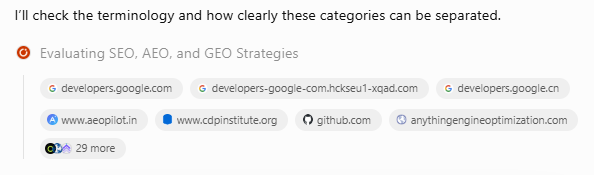
Example of GPT Search:
Gemini:
Quando você perguntou "qual o melhor lugar para ficar em Blue Mountain", a seleção considerou os seguintes fatores:
1. Proximidade Geográfica e Dados de Mapa (Local SEO)
- O que foi analisado: Coordenadas exatas, limites de bairro/montanha e cadastros no Google Perfil de Empresa (antigo Google Meu Negócio).
- Por que apareceram: proximidade
2. Autoridade de Entidade e Consenso na Web (GEO/AEO)
- O que foi analisado: Frequência com que as marcas são citadas em guias de viagem, blogs de turismo, portais de reserva (Booking, TripAdvisor) e notícias quando o assunto é "Blue Mountain".
- Por que apareceram: Modelos generativos buscam o consenso. Se dezenas de artigos sobre "onde ficar em Blue Moutain" apontam o X como referência de luxo/casais e citam o aluguel de temporada (Airbnb) como padrão da parte baixa, o sistema entende essas entidades como as respostas mais confiáveis para a intenção da pergunta.
3. Alinhamento Semântico com a Intenção do Usuário (AEO)
- O que foi analisado: Como a pergunta "melhor lugar" é ampla (pode significar luxo, economia, família ou localização), a resposta foi estruturada por perfis de viajante.
- Por que apareceram: Os dados públicos dessas empresas continham atributos claros que permitiram essa categorização:
- X: palavras-chave fortes ligadas a "casais", "spa", "ofurô", "vista para a montanha" e "sustentabilidade".
- Y a "natureza", "lago", "ambiente familiar" e "custo-benefício".
- Z: associadas a "apart-hotel", "cozinha", "ski out/frente à montanha" e proximidade com restaurantes.
4. Reputação e Avaliações
- O que foi analisado: Notas médias e volume de avaliações de usuários em plataformas públicas.
- Por que apareceram: Estabelecimentos com histórico consistente de boas avaliações têm maior peso na hora de responder a consultas que usam superlativos como "o melhor".
Em resumo: Para uma empresa aparecer organicamente nesse tipo de resposta (estratégia de AEO/GEO), o mais importante é ter o cadastro local atualizado (horários, fotos, categoria e localização exata), boas avaliações reais e menções consistentes em sites terceiros que associem o nome da marca ao diferencial específico que ela entrega.
Other summary:
- GEO extends SEO; it doesn't replace it. AI search systems still depend on accessible, useful, technically sound, and credible content, so your SEO foundations stay the base layer in 2026.
- Entity clarity is the fastest early win. Consistent brand, category, product, author, and proof signals across owned and third-party sources reduce the ambiguity that produces inaccurate AI descriptions.
- Citation-worthiness comes from evidence. First-party research, documentation, named experts, and dated claims carry weight that answer blocks alone cannot.
Sources: